Pamela Wheeler·Fellows's friendship with and care relationship with Alf Joseph
Pamela's WarPamela Wheeler/Fellows's friendship with and care relationship with Alf Joseph is one of the book's clearest examples of affection becoming practical protection. Alf is not merely an adult acquaintance: as a childless family friend, he takes Pamela under his wing, gives her access to horses and adult companionship, treats her as a willing partner in play, and later helps house her family after war destroys their home. The relationship therefore moves from leisure and instruction into wartime care without losing its warmth or humor.
Identity and Early Bond
Alf Joseph and his wife, Leah Joseph, are close family friends of Pamela's family. They are childless, and this circumstance helps explain the particular place Alf occupies in Pamela's childhood: he is a grown-up companion who offers attention without the ordinary distance between an adult and a child. Pamela spends weekends with her friend Gloria but also has the company of adults, among them Alf and Leah, and describes the Josephs as exceptionally kind. Their generosity is not presented as a single act. It becomes a continuing pattern that will later provide the whole family with refuge.
Alf's care is expressed through action rather than solemn declaration. He takes Pamela to the local riding school, pays for her lessons, and teaches her everything he knows about horses. He then accompanies her on hacks through the lanes and bridle paths around Stakenbridge. The arrangement gives Pamela both instruction and confidence: after several months she learns to find her seat, rise to the trot, and control her mount, becoming a confident rider rather than a passive passenger in Alf's adult world.
Shared Horses and Shared Confidence
Their rides create a distinct space of equality and exhilaration. The route from Stakenbridge crosses a large grass meadow before reaching the roads, allowing Alf and Pamela to let the horse and pony run. Pamela's little mare is fast and feisty, and although Alf rides a seventeen-hand horse with much longer legs, the pony keeps pace at a gallop and often wins the race. Alf's role is still that of teacher and protector, but the races give Pamela room to surpass him. His care does not require her submission; it helps produce competence, daring, and pleasure in her own ability.
The riding partnership also welcomes comic disruption. Max Wall, a famous hotel guest and comedian known for his unusual appearance and funny walk, insists that it is time he joined one of the rides, despite having no previous riding experience. Alf's willingness to let the situation become a spectacle reflects the playful atmosphere surrounding his relationship with Pamela. She is not simply being supervised; she is drawn into the adults' jokes, adventures, and social world, with Alf as the person who makes that inclusion possible.
Humour as Care and Collaboration
Alf has a pronounced sense of humour, and Pamela often serves as his sidekick and assistant in practical jokes. Their most elaborate scheme begins with a rumour that a very rare creature has been seen locally. The rumour develops into an exhibition: the creature is supposedly captured, posters are produced, and customers are invited to pay half a crown to see it. Alf supplies the showmanship, while Pamela collects the money as the queue forms outside the greenhouse.
The revelation is an enormous black kettle, described as the biggest water otter in the county. The arrangement is carefully managed so that customers enter through one door and leave through another, preventing those who have already seen the object from warning those still waiting. The deception is not treated as malicious exploitation. The money goes to charity, and the disappointed visitors accept the trick as clever entertainment worth the price. Pamela's participation matters because it shows the relationship operating through trust and shared performance: Alf gives her responsibility within the joke, and she helps convert his eccentric invention into a communal event.
Refuge During Wartime Displacement
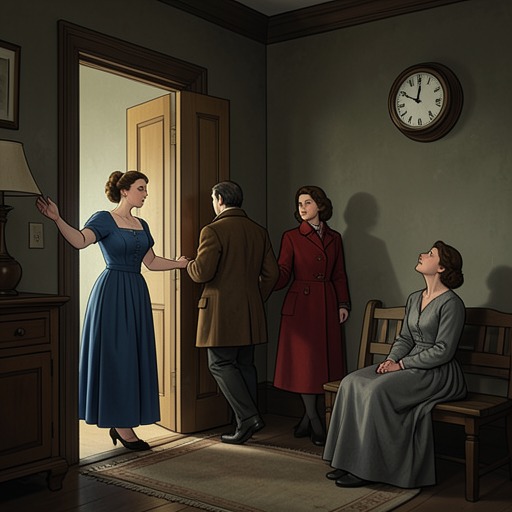
The relationship acquires its deepest significance after Pamela's family is bombed out of a home where they had barely spent a night. Friends of her parents, Jim and Renee Parkes, first take them into the tiny accommodation above their cafe in Quinton. When that hospitality ends, the Josephs receive them in Hagley. Pamela remembers spending several weeks with Alf and Leah as cherished guests, making their home a second refuge at a moment when the family has lost ordinary stability.
This later care gives retrospective weight to Alf's earlier kindness. The riding lessons had expanded Pamela's freedom; the practical jokes had given her a place within adult fellowship; the wartime shelter protects the family materially. The Josephs' hospitality belongs to a wider wartime network in which survival depends on friends opening constrained domestic spaces to displaced people. It is especially notable that the family arrives after the Parkes household has already been described as tiny and crowded: refuge is not abundance, but the deliberate conversion of limited space into welcome.
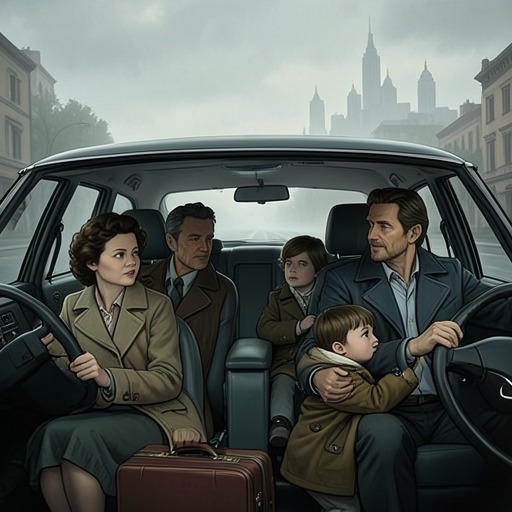
The move to Hagley occurs amid wider wartime shortages. Pamela's mother must give up the family car because petrol is no longer available, while Pamela's father struggles to find a permanent home. Against that background, the Josephs' shelter is more than social courtesy. It compensates, however temporarily, for the loss of transport, housing, and the familiar hotel environment. Alf and Leah provide continuity when the material conditions of family life have been stripped away.
Narrative and Thematic Significance
Pamela's bond with Alf stands in contrast to the war's destructive separations. The bombing of Coventry and other cities divides families, evacuates children, and turns homes into precarious possessions; later, the disappearance and death of young men make absence a repeated fact of civilian life. Alf's relationship with Pamela offers the opposite movement. Instead of removing someone from her world, it enlarges her world through teaching, companionship, and shelter; instead of making affection helpless before circumstance, it turns affection into a place where the displaced can stay.
The relationship also links private care to the book's broader account of wartime solidarity. People offer lifts to strangers, share scarce resources, and help one another endure shortages; the Josephs enact that communal spirit at the scale of the family. Their generosity is not sentimental decoration around the war narrative. It is one of the concrete means by which Pamela's family gets through it. Alf's humour, meanwhile, keeps care from becoming purely grim: the races, the inexperienced comedian on horseback, and the fraudulent water otter preserve mischief and laughter before and amid the years of danger.
For Pamela, Alf is therefore both mentor and ally. He teaches a practical skill, gives her confidence in her body and judgment, and makes her a participant in adult life, while his household later becomes a haven when the war makes housing uncertain. The relationship's decisive arc runs from being taken under his wing to being taken in by his family. Its emotional force lies in that continuity: the same man who helps a girl race her pony across a meadow also helps her family survive the loss of home.